
A Higher Standard of Heat: Inside Our ISO 9001:2015 Certification
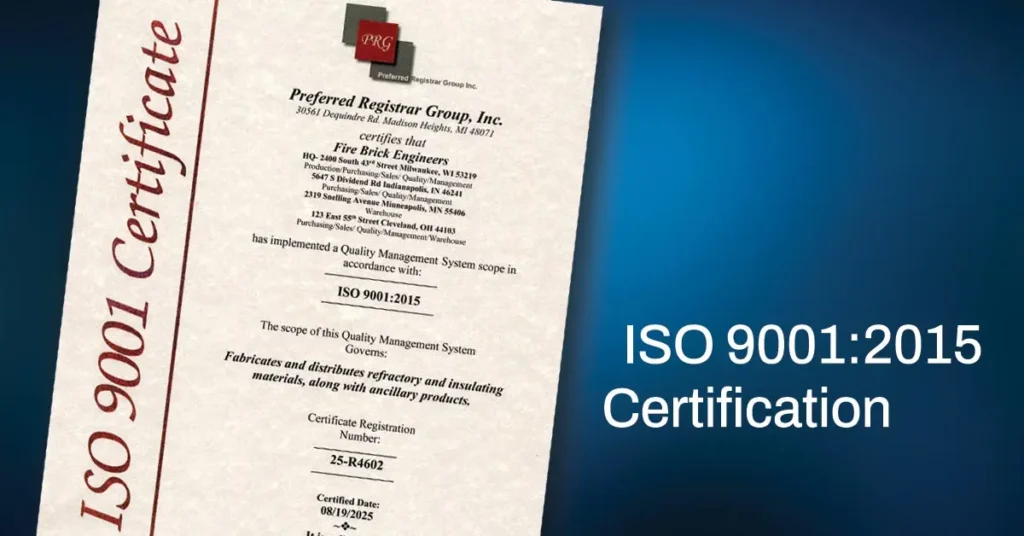
At Fire Brick Engineering, we’ve built our reputation on hard work, industry expertise, and reliability — even under pressure. Behind every successful furnace production and refractory installation is a system of checks and balances that helps us ensure consistent quality.
In 2025, we took that system to the next level by achieving ISO 9001:2015 certification. We view this as a significant milestone in our growth and evolution. With our certification, we’re now part of a select tier of refractory companies that operate under internationally recognized quality management standards. Here’s how we made the certification happen.
The Challenge: Building a Quality System Worth Certifying
The year-long ISO certification process requires intense preparation and cross-department collaboration. We underwent formal audits of Fire Brick Engineering’s Milwaukee, WI, headquarters and Nock Refractories Group in Cleveland, OH.
But earning the ISO 9001:2015 certification wasn’t just about passing an audit or a test. It was about proving that the quality of our work is ingrained in every step of our operations. Our system works well and thrives under pressure.
What ISO 9001:2015 Certification Means
ISO 9001:2015 certification is an internationally recognized standard verifying a company’s commitment to quality management, consistency, and continual improvement. For Fire Brick Engineering, the certification underscores the philosophy behind our operations and shows that we meet the globally accepted benchmarks for quality and performance.
ISO 9001:2015 defines the requirements for a Quality Management System (QMS). A QMS is a structured business framework that includes measures to verify that products and services meet customer and regulatory standards.
Our QMS is built around these principles:
- Customer Focus: Every process is designed for satisfaction and long-term trust.
- Leadership & Accountability: Quality is the responsibility of everyone in our company.
- Process Control: Processes are documented and measured from the first raw-material inspection through the final shipment.
- Continuous Improvement: Regular audits and performance reviews help us continue to grow and refine our approach to safety, efficiency, and reliability.
The “2015” in the standard ISO 9001:2015 indicates that the certification standards were revised that year. The amended standards place greater emphasis on risk management, strategic alignment with broader business objectives, and quality awareness at all levels.
The certification process is quite rigorous, but fortunately, it aligned with many of our existing best practices.To prepare for the task, we developed and documented internal procedures, ensuring they met ISO requirements. We conducted internal audits and management reviews to uncover opportunities for improvement.
Once our internal preparation was complete, we underwent a formal certification audit from an accredited third-party auditor. After the audit, we implemented additional improvements before final approval.
Both our Milwaukee headquarters and subsequent field offices in Minneapolis and Indianapolis along with Nock Refractories Group in Cleveland successfully passed their audits. We earned certification with only one minor (quickly corrected) non-conformance and several opportunities for improvement that we immediately acted upon.
Why ISO Certification Matters
Our existing customers were familiar with our high standards and commitment to quality. The ISO certification simply reinforced what they already knew from experience:
- Every product meets strict quality standards.
- Internal processes are controlled, traceable, and consistent.
- Fire Brick Engineers is committed to transparency, accountability, and continuous improvement.
Earning the ISO 9001:2015 certification offered a layer of reassurance to strengthen our key supplier partnerships. The certification also gives us greater market credibility, both here in the USA and globally.
We started the process with an already strong culture of accountability and field expertise, so formalizing those strengths into documented and audit-friendly systems was the logical next step. Every process had to be reviewed, standardized, and confirmed to align with ISO’s requirements.
The process itself took almost a year, with internal audits, documentation reviews, and action items — all of which had to happen while daily operations continued full steam ahead. We had major projects underway and crews in the field, but we met the challenge to refine the way Fire Brick Engineers operates.
“It wasn’t easy,” said our Quality Lead. “We were learning and working at the same time. Every procedure, record, and form had to tell the same story: we do what we say, and we have the records to prove it.”
The ISO Certification Journey
We started our certification journey over a year before the actual certification was awarded. Leadership determined that it was a savvy next step to demonstrate our commitment to consistency and quality. The goal was to reinforce what our existing clients knew while opening us up to new industrial partners evaluating Fire Brick Engineers for large-scale contracts.
Step 1: Preparation and Internal Audits
The first several months of the ISO certification process were devoted to preparation and organization. We developed an internal audit schedule that mapped out the processes under ISO’s scope.
Our team got to work collecting documentation, identifying gaps, and creating a centralized quality manual to standardize practices across the entire company. Internal audits were conducted within individual departments and included cross-functional oversight from project managers and administrative staff.
The early audits helped us verify our compliance with our stated processes (putting our money where our mouth is) and helped us uncover areas that needed more documentation, organization, or training.
“The early audits were like holding up a mirror, where we could see what was working and what wasn’t. Then the whole team became part of the fix,” said our Quality Lead.
Step 2: Corrective Actions and OFIs
Once we wrapped up the internal audits, we moved to the next phase of the process: corrective actions and Opportunities for Improvement (OFIs)—every identified issue needed to be systematically addressed.
The second stage of the ISO certification process called for collaboration. It meant that field supervisors needed to share insights from their job sites, while sales teams shared their perspective on quoting and client-facing interactions. Our leadership team ensured that policy and process updates were approved and cross-checked. Each OFI had to be effective and sustainable—did it meet the ISO requirements? Did it complicate or streamline our daily operations?
Step 3: Formal ISO Certification Audit
For three weeks in the fall, the formal ISO 9001:2015 certification audit was conducted. An external auditor visited our headquarters and reviewed all the pieces of our quality management and process systems. They looked at purchasing and production, customer satisfaction, and how well we worked to correct mistakes.
The result? Both facilities passed! Our Milwaukee headquarters and the Nock Refectories Group had a successful audit. Only one non-conformance was identified and corrected on the spot. The auditor’s final report highlighted how prepared and engaged our team was from the get-go.
Once we got word that the “certificate was in the mail,” we felt a mix of relief and pride over how much work had gone into the process.
ISO Certified, Strengthened, and Future-Ready
When our confirmation arrived, the entire organization celebrated. This wasn’t just a certificate to frame and hang on the office wall; it was validation — proof that our processes, people, and company culture aligned with international standards for excellence in our industry.
Outcomes of the process included:
- Successful certification of all locations in the first attempt.
- Zero unresolved non-conformances post-audit.
- System-wide adoption of standardized documentation practices.
- Strengthened communication across departments.
- Leadership gained hands-on experience in every aspect of quality management.
- A strengthened foundation for growth, acquisitions, and new partnerships.
We display our ISO 9001:2015 certification on our website, marketing materials, and customer materials as a mark of trust that reinforces our reliability for our existing and prospective clients.
Our customers have confidence that every job follows a clear, repeatable, and documented process. Our materials, testing, and approvals are tracked and traceable throughout the process. They can expect consistency in quality standards, no matter where a project takes place. Most of all, they can expect reliability and accountability with fewer errors and faster corrections.
We know our clients manage high-temperature equipment, where downtime is costly and risk is real. ISO certification lets everyone know that at Fire Brick Engineers, we offer proven and reliable systems they can depend on.
While passing the audit was a company milestone, it’s certainly not the finish line. Our ISO certification will require ongoing monitoring, regular audits, and plenty of documentation. It’s about control and consistency—identifying learning opportunities and turning our discoveries into improvement.
Fire Brick Engineer’s ISO 9001:2015 certification marks the next chapter for our company, which is already well-known for our commitment to quality and grit. It’s the people on our team who help ensure we can make that quality measurable and repeatable.
The certification doesn’t change how we operate, but it offers a symbol of trust for our customers. It’s proof that a company forged in heat can thrive under scrutiny and come out even better.
If you have questions about working with Fire Brick Engineers, please reach out today. We’re happy to explore our products and services with you to decide on the best option for your next refractory project.